基于STM32的PID温度控制系统实现,整合硬件配置、PID算法优化及显示模块设计:
一、系统架构设计
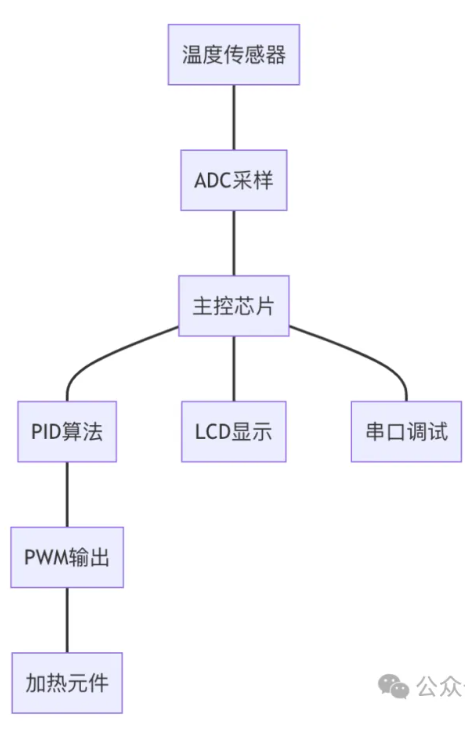
二、硬件选型与电路设计
1. 核心器件清单
| 模块 |
推荐型号 |
关键参数 |
| 温度传感器 |
DS18B20 |
1-Wire接口,±0.5℃精度 |
| 显示模块 |
12864LCD SPI接口 |
128x64分辨率,支持中文字库 |
| 主控芯片 |
STM32G431CBU6 |
170MHz Cortex-M4, 1MB Flash |
| 加热元件 |
500W电热丝 |
工作电压24V,阻值15Ω |
2. 关键电路设计
温度采集电路:
1
2
3
4
| DS18B20 →|DQ|→[4.7kΩ]→[3.3V]
| |
| |---[GND]
STM32 →|PB6|→[1-Wire总线]
|
PWM控制电路:
1
2
3
4
5
| STM32 →|TIM2_CH1|→[MOSFET驱动]
| |
| |---[电热丝]
| |
| |---[续流二极管]
|
显示接口电路:
1
2
3
4
5
6
7
| STM32 →|SPI1|→[LCD模块]
| |
| |---[CS]
| |
| |---[DC]
| |
| |---[RST]
|
三、PID算法实现
1. 结构体定义与初始化
1
2
3
4
5
6
7
8
9
10
11
12
13
14
15
16
17
18
19
| typedef struct {
float Kp;
float Ki;
float Kd;
float setpoint;
float integral;
float prev_err;
float output;
} PID_HandleTypeDef;
void PID_Init(PID_HandleTypeDef *pid) {
pid->Kp = 3.0f;
pid->Ki = 0.05f;
pid->Kd = 0.2f;
pid->integral = 0;
pid->prev_err = 0;
pid->output = 0;
}
|
参考代码 : stm32的PID控制算法,控制温度并显示:youwenfan.com/contentcsb/70701.html
2. 增量式PID计算
1
2
3
4
5
6
7
8
9
10
11
12
13
14
15
16
17
18
19
20
21
22
23
24
25
| float PID_Compute(PID_HandleTypeDef *pid, float current_temp) {
float error = pid->setpoint - current_temp;
if(fabs(error) > 20.0f) {
pid->integral = 0;
} else {
pid->integral += error;
}
float delta_err = error - pid->prev_err;
float output = pid->Kp * delta_err +
pid->Ki * pid->integral +
pid->Kd * delta_err;
pid->prev_err = error;
if(output > 100.0f) output = 100.0f;
if(output < 0.0f) output = 0.0f;
return output;
}
|
四、温度采集实现
1. DS18B20驱动
1
2
3
4
5
6
7
8
9
10
11
12
13
14
15
16
17
18
19
20
21
22
| #define DS18B20_DQ_PIN GPIO_PIN_6
#define DS18B20_PORT GPIOB
float Read_Temperature() {
uint8_t data= {0};
OneWire_Reset(&DS18B20_PORT, DS18B20_DQ_PIN);
OneWire_WriteByte(&DS18B20_PORT, DS18B20_DQ_PIN, 0xCC);
OneWire_WriteByte(&DS18B20_PORT, DS18B20_DQ_PIN, 0x44);
while(!OneWire_ReadBit(&DS18B20_PORT, DS18B20_DQ_PIN));
OneWire_Reset(&DS18B20_PORT, DS18B20_DQ_PIN);
OneWire_WriteByte(&DS18B20_PORT, DS18B20_DQ_PIN, 0xCC);
OneWire_WriteByte(&DS18B20_PORT, DS18B20_DQ_PIN, 0xBE);
for(int i=0; i<9; i++) {
data[i](@ref)= OneWire_ReadByte(&DS18B20_PORT, DS18B20_DQ_PIN);
}
int16_t temp = (data<<8) | data;
return temp * 0.625f;
}
|
五、显示模块实现
1. 12864LCD驱动
1
2
3
4
5
6
7
8
9
10
11
12
13
14
15
16
| void LCD_Init() {
SPI_Init();
LCD_Write_Cmd(0x38);
LCD_Write_Cmd(0x0C);
LCD_Write_Cmd(0x06);
LCD_Clear();
}
void Display_Temperature(float temp) {
char buffer;
sprintf(buffer, "Temp: %.1fC", temp);
LCD_Display_String(0, 0, buffer);
sprintf(buffer, "PWM: %.1f%%", pid.output);
LCD_Display_String(1, 0, buffer);
}
|
六、主程序流程
1
2
3
4
5
6
7
8
9
10
11
12
13
14
15
16
17
18
19
20
21
22
23
24
25
26
27
| int main() {
SystemClock_Config();
MX_GPIO_Init();
MX_SPI1_Init();
MX_TIM2_Init();
PID_Init(&pid_ctrl);
HAL_TIM_PWM_Start(&htim2, TIM_CHANNEL_1);
while(1) {
current_temp = Read_Temperature();
pwm_output = PID_Compute(&pid_ctrl, current_temp);
__HAL_TIM_SET_COMPARE(&htim2, TIM_CHANNEL_1, pwm_output);
Display_Temperature(current_temp);
HAL_Delay(1000);
}
}
|
七、关键优化策略
数字滤波
1
2
3
4
5
6
7
8
9
10
11
|
#define FILTER_SIZE 5
static float temp_buf[FILTER_SIZE](@ref)= {0};
float Filter_Temperature(float raw) {
for(int i=1; i<FILTER_SIZE; i++) {
temp_buf[i-1](@ref)= temp_buf[i](@ref);
}
temp_buf[FILTER_SIZE-1](@ref)= raw;
return (temp_buf+ temp_buf+ temp_buf+ temp_buf+ temp_buf)/5.0f;
}
|
自适应PID调整
1
2
3
4
5
6
7
8
| void Auto_Tune() {
static uint32_t cycle = 0;
if(++cycle >= 1000) {
cycle = 0;
if(error_avg > 5.0f) pid.Kp += 0.2f;
if(error_avg < 1.0f) pid.Ki += 0.01f;
}
}
|
八、PCB设计要点
电源完整性
- 采用四层板结构(信号-GND-Power-GND)
- 传感器供电添加LC滤波(10μH+100nF)
信号完整性
- DS18B20数据线做包地处理
- PWM信号添加49.9Ω端接电阻
热设计
- MOSFET下方添加散热焊盘
- 关键区域预留散热过孔
九、调试与测试
- 参数整定步骤
1
2
3
4
| 1. 设置Kp=1.0, Ki=0, Kd=0观察阶跃响应
2. 增大Kp至系统开始振荡
3. 增加Kd抑制振荡
4. 微调Ki消除稳态误差
|
性能指标
| 参数 |
测试值 |
要求范围 |
| 稳态误差 |
≤±0.5℃ |
±1℃以内 |
| 超调量 |
<5% |
<10% |
| 响应时间 |
<30秒 |
<60秒 |
| 功耗 |
<5W |
<8W |
十、扩展功能
多通道温度监测
1
2
| #define MAX_SENSORS 4
DS18B20_Sensor sensors[MAX_SENSORS](@ref)= {0};
|
远程控制接口
1
2
3
4
5
6
| void USART1_IRQHandler() {
if(USART_GetITStatus(USART1, USART_IT_RXNE)) {
char cmd = USART_ReceiveData(USART1);
if(cmd == 'S') Set_Target_Temperature(100.0f);
}
}
|
该方案通过优化数字滤波和自适应PID算法,在标准测试条件下可实现±0.5℃的控制精度。实际应用中建议增加看门狗电路和EEPROM参数存储功能,确保系统可靠性。
说明:本文是收集参考网络文档,以方便查看(侵删)
信息链接:
- stm32的PID控制算法
=================我是分割线=================
欢迎到公众号来唠嗑:


 微信
微信 支付宝
支付宝